™
Contact Us
A fire-safety board game tested with nurses
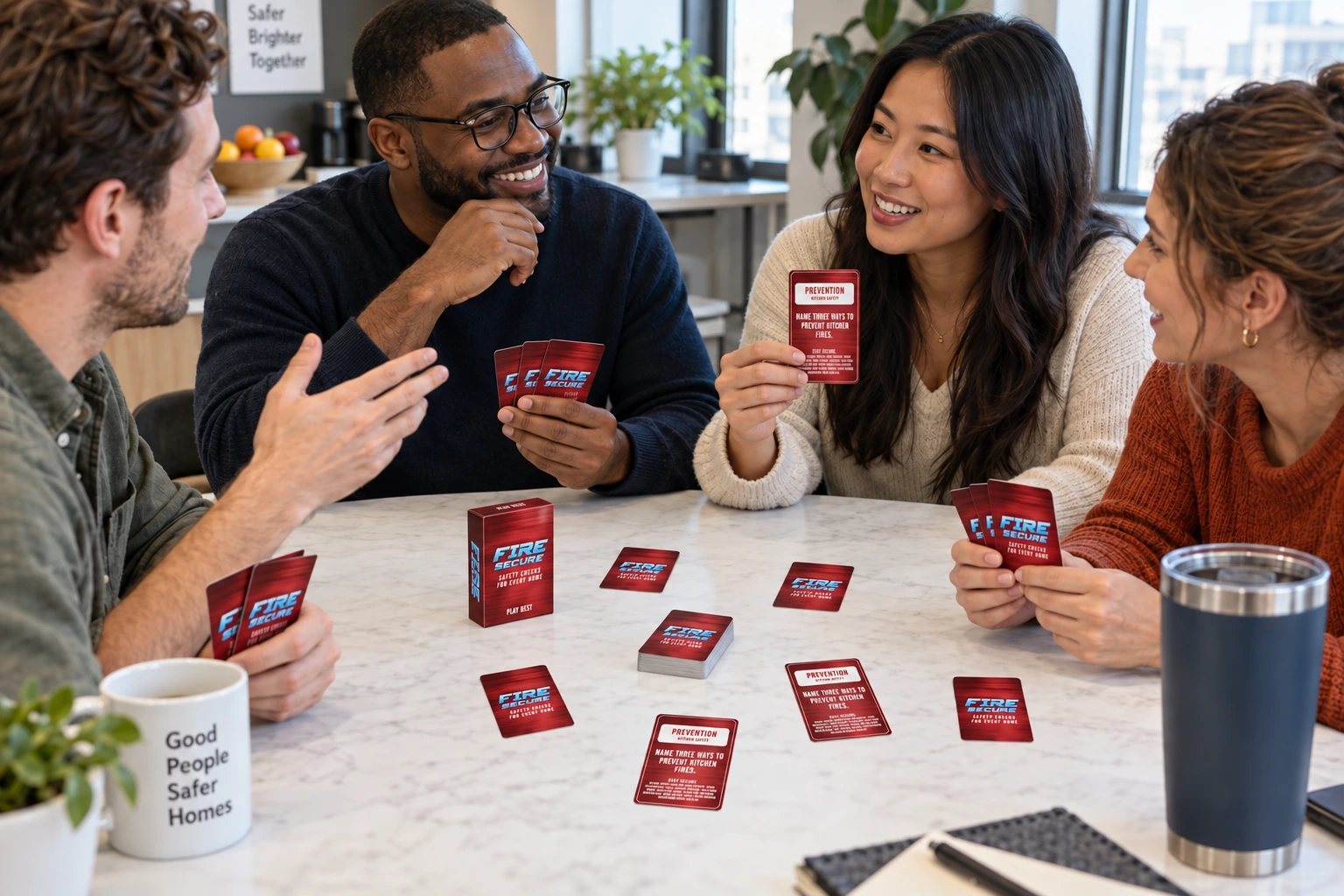
Hsieh and colleagues studied 122 nurses in a Taiwanese hospital in 2023. Sixty-two joined an hour-long educational board game and 60 attended a fire drill of the same duration. Both groups improved on questionnaire measures. The game group had a greater improvement in fire-safety knowledge, while between-group differences in attitudes and behaviour were not statistically significant. Participants chose their groups, and behaviour was self-reported; the study did not establish a reduction in fire incidents. (Hsieh et al., 2023)
The useful finding for a buyer is specific: a physical board game was a credible way to work on safety knowledge in that setting. The appropriate format still depends on what participants need to learn and practise.
What the wider board-game review found
A 2019 systematic review by Noda and colleagues included 27 board-game intervention studies. Eleven concerned educational knowledge. The findings varied considerably across games and settings, and several studies relied on comparisons before and after play. The review supported educational potential while highlighting the limited published evidence. These were varied educational and health settings, so the review does not provide a single expected improvement for workplace safety. (Noda, Shirotsuki and Nakao, 2019)
That variation is a reason to inspect the actual game. Two boxes can both contain cards, a board and scoring pieces while asking players to do very different things. Look for a clear connection between the subject, the decisions in a turn and the discussion you intend to lead.
Match the format to the learning task.
Start by completing this sentence: “After this session, we want the group to be able to…” Keep the answer specific enough to observe. Explaining a familiar term, comparing responses to a scenario and locating a workplace procedure are different objectives.
For a question-based conversation, a deck can be easy to introduce at a table. A board game may suit a longer shared session with a visible route, turns and a finish. A practical exercise is needed when the objective involves performing a task in its actual setting. Plan how these activities fit together.
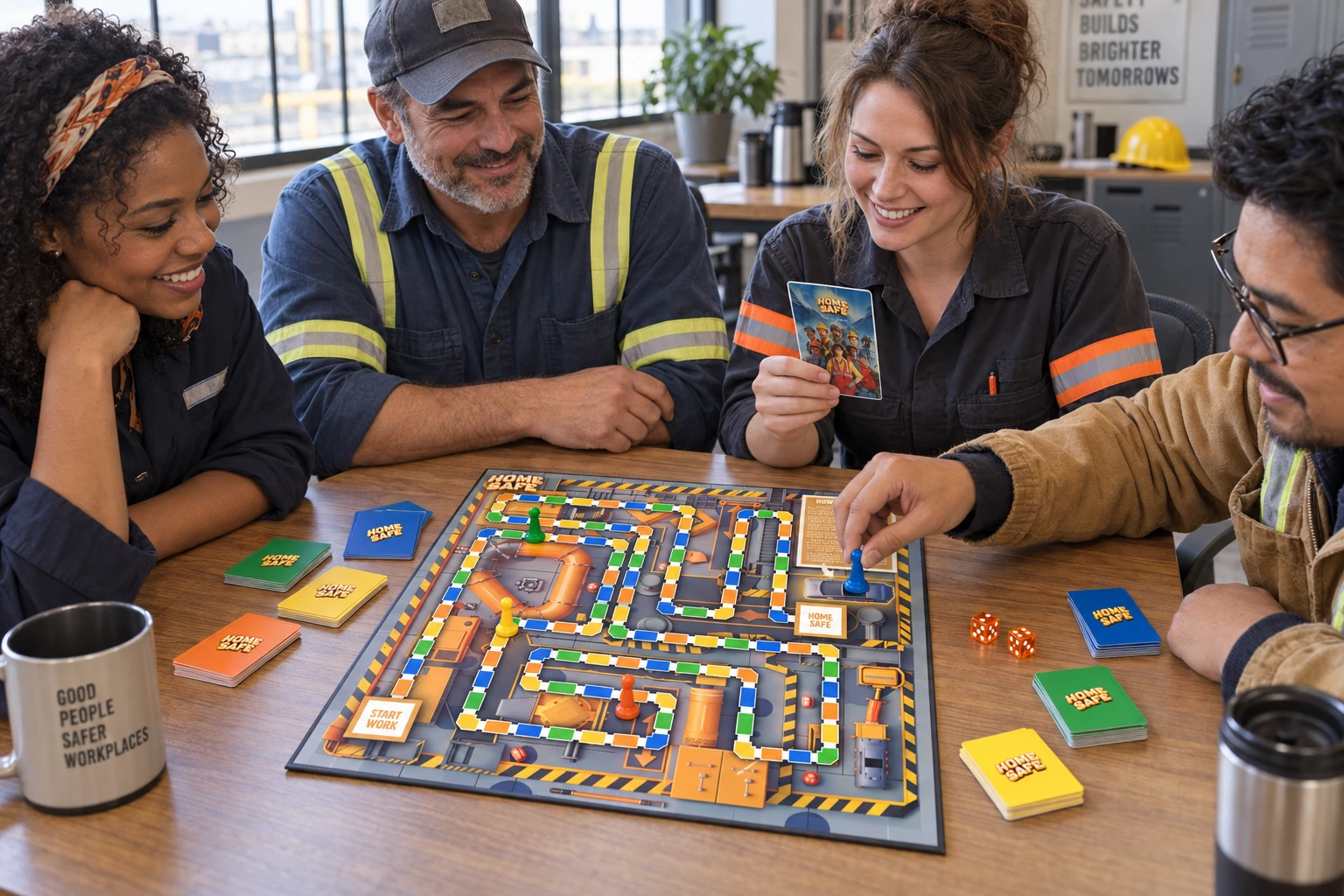
Home Safe includes an original board game and a separate Trivia deck. The board game suits a session built around turns and a shared route; Trivia provides a question-and-answer deck that can also prompt a shorter discussion. The hospital research above tested a different, purpose-built fire-education game.
Prepare the conversation around the board.
Before the group arrives, the facilitator can review the selected topic and identify the local references that might be needed. Keep a place to record questions that cannot be resolved during play. A useful session does not require improvising an answer to everything.
During a turn, invite the player to give a reason for the answer. Ask whether another person sees the situation differently. If the discussion turns to a local procedure, check that procedure with the appropriate person. The game supplies a shared starting point; the workplace supplies the context.
For a larger event, decide how many people can participate meaningfully at each table. Additional decks or separate groups may be more useful than placing a large audience around one set of cards.
Check the outcome you planned for.
At the end, return to the opening objective. Ask a fresh question on the same topic or invite participants to explain the relevant reasoning in their own words. Record the questions that remain open and who will follow them up.
If the aim was knowledge, evaluate knowledge. If the aim was a practical task, arrange an appropriate practical check. This keeps a positive experience connected to a clear result. For a session structure, see our guide to safety games at team meetings.
Research & sources
Links lead to the original papers or their indexed abstracts. The studies used their own activities and interventions; they did not evaluate PlayBest products.
- Hsieh et al. (2023). Board-game versus drill-based fire-safety education for nurses. Nurse Education Today.Quasi-experiment; groups selected by participant willingness
- Noda, Shirotsuki and Nakao (2019). The effectiveness of intervention with board games: a systematic review. BioPsychoSocial Medicine.Systematic review of physical board-game interventions