™
Contact Us

What a laboratory induction study measured
Rafiq and colleagues reported a 2025 study of university foundation-year students using games about hazard symbols, personal protective equipment and laboratory equipment. Among 91 students completing the before-and-after survey, average self-rated health and safety knowledge rose from 6.4 to 8.4 on a 10-point scale. The session included a short introduction and three 15-minute games. It measured perceived knowledge, with no separate control group or long-term injury outcome. (Rafiq et al., 2025)
The study offers a concrete example of people working with physical cards during an induction. The increase describes how much students felt they knew. An objective knowledge check would be needed to establish how accurately they could apply the material afterwards.
Give everyone a task they can explain.
A separate classroom study by Singh and Niranjan explored groups designing and playing board games about occupational health and safety. The authors reported learning benefits and useful experiences of communication, collaboration and teamwork. Because students also created and were assessed on the games, the intervention involved more than playing a ready-made deck. It was an educational study, not evidence of fewer workplace injuries. (Singh and Niranjan, 2012)
A practical question follows for your own induction: what will each person actually contribute? One person reading while everyone else watches is a different activity from each participant choosing, explaining and checking a response.
Build a short activity around one objective.
Here is a suggested approach for a facilitator. Choose a small set of examples from the material covered in the induction, such as the symbols people will encounter in their own work area. Give participants time to examine them individually, then ask pairs to describe what each example means and where they would find further information. Finish by checking the answers together.
Keep the scope narrow. A discussion about recognising a symbol is one activity. Knowing what action applies in a particular workplace is another. Make room to connect the example with the employer’s own instructions and the equipment or processes people will encounter.
Read the material aloud when helpful, and make the printed examples easy to see. Rotate who explains the group’s answer. These are practical facilitation choices to try and evaluate with your audience.
Match the card content to the induction
Different safety decks serve different purposes. The university study used games specifically designed for laboratory topics, including GHS chemical hazard pictograms. Those findings should not be treated as a test of every deck that contains a safety symbol.
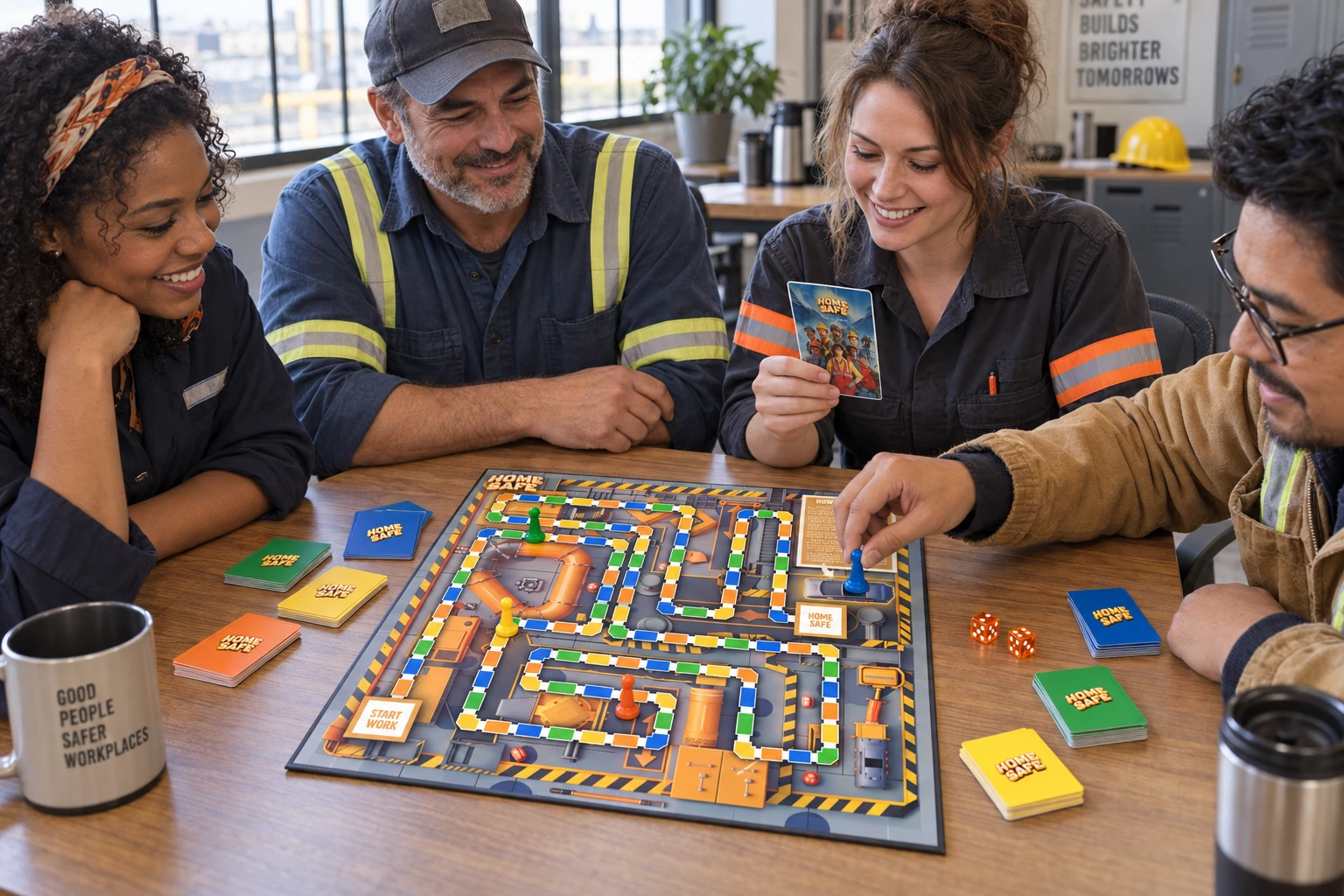
PlayBest Safety Playing Cards is a conventional 52-card deck with safety-themed artwork. Its familiar playing-card format can sit alongside an optional conversation about the imagery. A trivia deck such as Home Safe: Trivia gives a facilitator a different starting point: a question and an answer to discuss.
Review the sample artwork before choosing. Decide whether the game itself covers the learning objective or whether you are adding a separate, facilitator-led discussion. Tell participants which activity they are doing.
Follow confidence with a check of understanding.
At the end of an induction activity, asking whether people feel more familiar with a topic can be useful. Pair that feedback with a fresh example they can explain without help. This gives you two different pieces of information: their experience and their demonstrated understanding.
Keep any unanswered questions visible until someone follows them up. If you repeat the induction with another group, use those questions to improve the introduction and the choice of examples. Our measurement article includes a simple framework for recording what a session achieved.
Research & sources
Links lead to the original papers or their indexed abstracts. The studies used their own activities and interventions; they did not evaluate PlayBest products.
- Rafiq et al. (2025). Card games are effective tools to enhance foundation year health and safety inductions. FEBS Open Bio.University induction study; pre/post self-reported knowledge
- Singh and Niranjan (2012). Using groupwork in the designing and playing of board games in occupational health and safety. Groupwork.Classroom study of game design, play and student reflections